CD201 (EPCR) Monoclonal Antibody (eBio1560 (1560)), PE, eBioscience
PRODUCT DETAILS
Host: Rat
Isotype: IgG2b, kappa
Clonality: Monoclonal
Clone: eBio1560 (1560)
Format: PE
Reactivity: Ms
Application: Flow Cytometry
Tested Dilution: 1 µg/test
Concentration: 0.2 mg/mL
Storage: 4°C, store in dark, DO NOT FREEZE!
Formulation: PBS with 0.09% sodium azide; pH 7.2
Purification: Affinity chromatography
Data Sheet: TDS
Specific Information
Description: The eBio1560 monoclonal antibody reacts with mouse Endothelial Protein C Receptor (EPCR, CD201), a 25 kDa Type 1 transmembrane protein expressed on endothelial cells. EPCR exhibits sequence and structural homology with the MHC class I/CD1 family of proteins. EPCR is a ligand for Protein C and plays an important role in augmenting Protein C activation by the thrombin-thrombomodulin complex and in regulating blood coagulation and inflammation. Deletion of EPCR results in embryonic lethality, at least partically due to placental thrombosis.
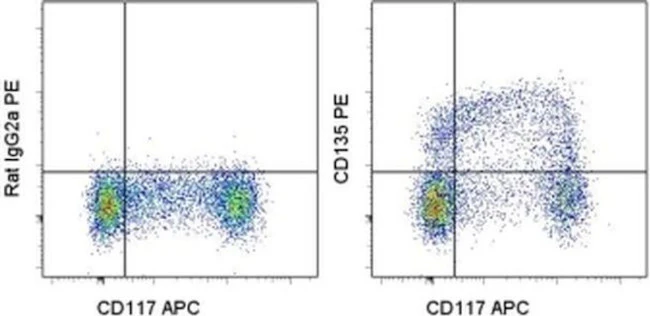
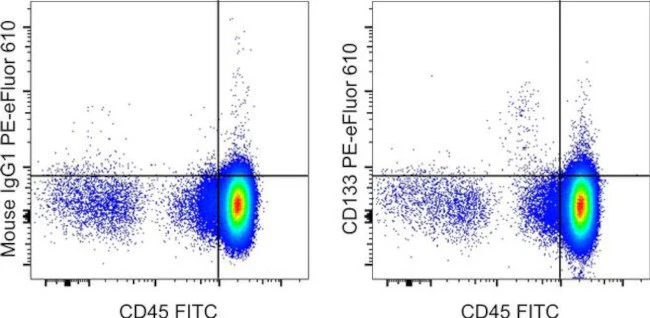
Recently, it was demonstrated that EPCR expression identified cells in the bone marrow that are capable of hematopoietic reconstitution activity comparable to hematopoietic stem cells isolated with conventional methods. The eBio1560 monoclonal antibody can be used for the detection of these hematopoietic stem cells, however the eBiomRCR-16 monoclonal antibody should only be used for the detection of CD201 on endothelial cells.
Applications Reported: This eBio1560 (1560) antibody has been reported for use in flow cytometric analysis.
Applications Tested: This eBio1560 (1560) antibody has been tested by flow cytometric analysis of the bEnd.3 cell line. This can be used at less than or equal to 1 µg per test. A test is defined as the amount (µg) of antibody that will stain a cell sample in a final volume of 100 µL. Cell number should be determined empirically but can range from 10^5 to 10^8 cells/test. It is recommended that the antibody be carefully titrated for optimal performance in the assay of interest.
Excitation: 488-561 nm; Emission: 578 nm; Laser: Blue Laser, Green Laser, Yellow-Green Laser.
Filtration: 0.2 µm post-manufacturing filtered.
For Research Use Only. Not for use in diagnostic procedures. Not for resale without express authorization.
Original: $423.00
-70%$423.00
$126.90
Description
PRODUCT DETAILS
Host: Rat
Isotype: IgG2b, kappa
Clonality: Monoclonal
Clone: eBio1560 (1560)
Format: PE
Reactivity: Ms
Application: Flow Cytometry
Tested Dilution: 1 µg/test
Concentration: 0.2 mg/mL
Storage: 4°C, store in dark, DO NOT FREEZE!
Formulation: PBS with 0.09% sodium azide; pH 7.2
Purification: Affinity chromatography
Data Sheet: TDS
Specific Information
Description: The eBio1560 monoclonal antibody reacts with mouse Endothelial Protein C Receptor (EPCR, CD201), a 25 kDa Type 1 transmembrane protein expressed on endothelial cells. EPCR exhibits sequence and structural homology with the MHC class I/CD1 family of proteins. EPCR is a ligand for Protein C and plays an important role in augmenting Protein C activation by the thrombin-thrombomodulin complex and in regulating blood coagulation and inflammation. Deletion of EPCR results in embryonic lethality, at least partically due to placental thrombosis.
Recently, it was demonstrated that EPCR expression identified cells in the bone marrow that are capable of hematopoietic reconstitution activity comparable to hematopoietic stem cells isolated with conventional methods. The eBio1560 monoclonal antibody can be used for the detection of these hematopoietic stem cells, however the eBiomRCR-16 monoclonal antibody should only be used for the detection of CD201 on endothelial cells.
Applications Reported: This eBio1560 (1560) antibody has been reported for use in flow cytometric analysis.
Applications Tested: This eBio1560 (1560) antibody has been tested by flow cytometric analysis of the bEnd.3 cell line. This can be used at less than or equal to 1 µg per test. A test is defined as the amount (µg) of antibody that will stain a cell sample in a final volume of 100 µL. Cell number should be determined empirically but can range from 10^5 to 10^8 cells/test. It is recommended that the antibody be carefully titrated for optimal performance in the assay of interest.
Excitation: 488-561 nm; Emission: 578 nm; Laser: Blue Laser, Green Laser, Yellow-Green Laser.
Filtration: 0.2 µm post-manufacturing filtered.
For Research Use Only. Not for use in diagnostic procedures. Not for resale without express authorization.