CD8b Monoclonal Antibody (eBio341 (341)), Functional Grade, eBioscience
PRODUCT DETAILS
Host: Mouse
Isotype: IgG1, kappa
Clonality: Monoclonal
Clone: eBio341 (341)
Format: Functional Grade
Reactivity: Rt
Application: Flow Cytometry
Tested Dilution: 0.5 µg/test
Concentration: 1 mg/mL
Storage: 4°C
Formulation: PBS with no preservative; pH 7.2
Purification: Affinity chromatography
Data Sheet: TDS
Specific Information
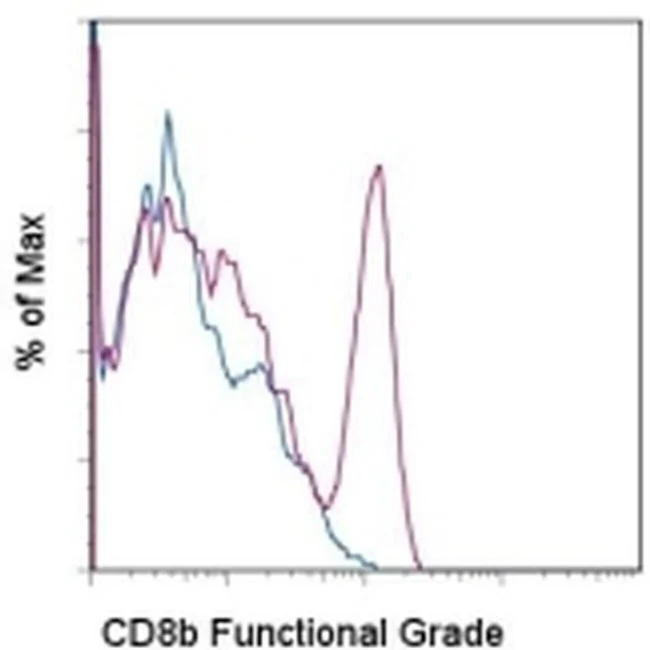
Description: The eBio341 monoclonal antibody reacts with rat CD8beta. CD8beta is a member of the immunoglobulin superfamily which heterodimerizes with CD8alpha to form the CD8 antigen expressed on CD4+CD8+, double-positive thymocytes, the majority of MHC class I-restricted peripheral T cells, and on some macrophages. CD8beta expression is absent in athymic mice, which are populated by T-cells expressing CD8alpha homodimers. This has led to the idea that CD8beta expression is dependent on the development of T cells in the thymus. CD8 binds to MHC class I expressed on the surface of antigen-presenting cells during antigen presentation, and participates in T-cell receptor signal transduction through association with the kinase Lck.
Applications Reported: This eBio341 (341) antibody has been reported for use in flow cytometric analysis and functional assays.
Applications Tested: This eBio341 (341) antibody has been tested by flow cytometric analysis of rat splenocytes and thymocytes. This can be used at less than or equal to 0.5 µg per test. A test is defined as the amount (µg) of antibody that will stain a cell sample in a final volume of 100 µL. Cell number should be determined empirically but can range from 10^5 to 10^8 cells/test. It is recommended that the antibody be carefully titrated for optimal performance in the assay of interest.
Storage and handling: Use in a sterile environment.
Filtration: 0.2 µm post-manufacturing filtered.
Purity: Greater than 90%, as determined by SDS-PAGE.
Endotoxin Level: Less than 0.001 ng/µg antibody, as determined by LAL assay.
Aggregation: Less than 10%, as determined by HPLC.
For Research Use Only. Not for use in diagnostic procedures. Not for resale without express authorization.
Description
PRODUCT DETAILS
Host: Mouse
Isotype: IgG1, kappa
Clonality: Monoclonal
Clone: eBio341 (341)
Format: Functional Grade
Reactivity: Rt
Application: Flow Cytometry
Tested Dilution: 0.5 µg/test
Concentration: 1 mg/mL
Storage: 4°C
Formulation: PBS with no preservative; pH 7.2
Purification: Affinity chromatography
Data Sheet: TDS
Specific Information
Description: The eBio341 monoclonal antibody reacts with rat CD8beta. CD8beta is a member of the immunoglobulin superfamily which heterodimerizes with CD8alpha to form the CD8 antigen expressed on CD4+CD8+, double-positive thymocytes, the majority of MHC class I-restricted peripheral T cells, and on some macrophages. CD8beta expression is absent in athymic mice, which are populated by T-cells expressing CD8alpha homodimers. This has led to the idea that CD8beta expression is dependent on the development of T cells in the thymus. CD8 binds to MHC class I expressed on the surface of antigen-presenting cells during antigen presentation, and participates in T-cell receptor signal transduction through association with the kinase Lck.
Applications Reported: This eBio341 (341) antibody has been reported for use in flow cytometric analysis and functional assays.
Applications Tested: This eBio341 (341) antibody has been tested by flow cytometric analysis of rat splenocytes and thymocytes. This can be used at less than or equal to 0.5 µg per test. A test is defined as the amount (µg) of antibody that will stain a cell sample in a final volume of 100 µL. Cell number should be determined empirically but can range from 10^5 to 10^8 cells/test. It is recommended that the antibody be carefully titrated for optimal performance in the assay of interest.
Storage and handling: Use in a sterile environment.
Filtration: 0.2 µm post-manufacturing filtered.
Purity: Greater than 90%, as determined by SDS-PAGE.
Endotoxin Level: Less than 0.001 ng/µg antibody, as determined by LAL assay.
Aggregation: Less than 10%, as determined by HPLC.
For Research Use Only. Not for use in diagnostic procedures. Not for resale without express authorization.