NOTCH1 Monoclonal Antibody (22E5), APC, eBioscience
PRODUCT DETAILS
Host: Rat
Isotype: IgG2a, kappa
Clonality: Monoclonal
Clone: 22E5
Format: APC
Reactivity: Ms
Application: Flow Cytometry
Tested Dilution: 1 µg/test
Concentration: 0.2 mg/mL
Storage: 4°C, store in dark, DO NOT FREEZE!
Formulation: PBS with 0.09% sodium azide; pH 7.2
Purification: Affinity chromatography
Data Sheet: TDS
Specific Information
Description: This 22E5 monoclonal antibody reacts with the extracellular domain of mouse Notch1, one of four members of the Notch family of receptors. Notch receptors are 300-kDa single-pass transmembrane proteins. While the extracellular domain contains numerous epidermal growth factor-like repeats for ligand binding, the intracellular domain is involved in cell signaling. Upon binding its membrane-bound ligand (either Delta or Jagged), the Notch receptor undergoes proteolytic cleavage, first by ADAM-family metalloproteases and then by gamma-secretase. The second cleavage event releases the Notch intracellular domain (NICD), which subsequently translocates into the nucleus, heterodimerizes with the DNA-binding protein RBP-J, recruits co-activator molecules, and ultimately activates transcription.
Notch 1 is expressed on thymocytes, bone marrow hematopoietic stem cells, T and NK cells. Lower Notch1 expression levels can be found on B cells and monocytes. Studies show that some subsets of T-cell acute lymphoblastic leukemia (T-ALL) arise due to Notch1 chromosomal translocation with TCRbeta, which results in the expression of constitutively active Notch1. This cell surface receptor is involved in T cell lineage commitment, thymocyte development, and Th2 differentiation.
Applications Reported: This 22E5 antibody has been reported for use in flow cytometric analysis.
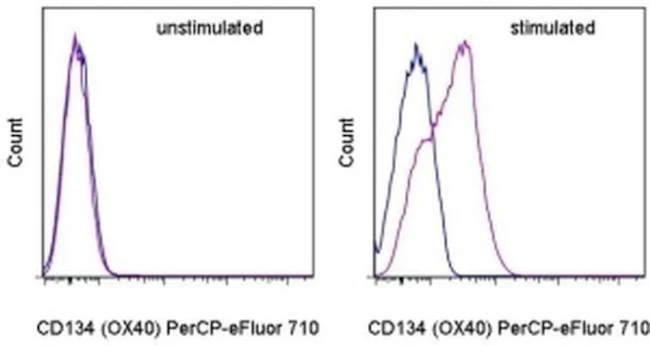
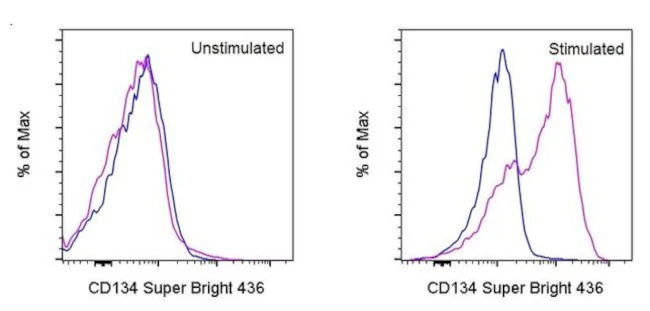
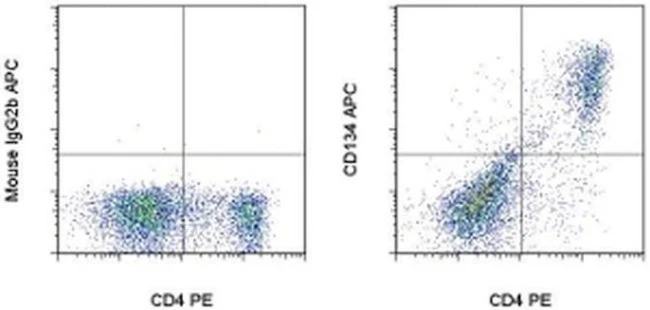
Applications Tested: This 22E5 antibody has been tested by flow cytometric analysis of 24-hour CD3-stimulated mouse splenocytes. This can be used at less than or equal to 1 µg per test. A test is defined as the amount (µg) of antibody that will stain a cell sample in a final volume of 100 µL. Cell number should be determined empirically but can range from 10^5 to 10^8 cells/test. It is recommended that the antibody be carefully titrated for optimal performance in the assay of interest.
Excitation: 633-647 nm; Emission: 660 nm; Laser: Red Laser.
Filtration: 0.2 µm post-manufacturing filtered.
For Research Use Only. Not for use in diagnostic procedures. Not for resale without express authorization.
Original: $348.00
-70%$348.00
$104.40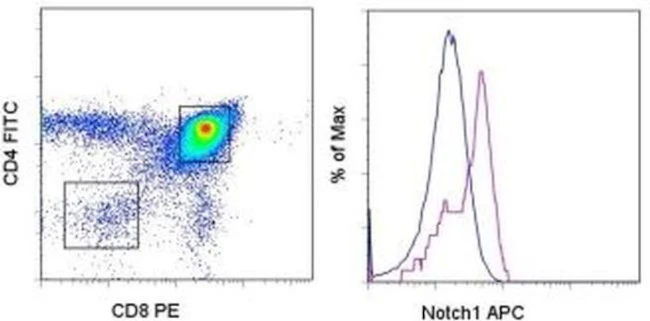
Description
PRODUCT DETAILS
Host: Rat
Isotype: IgG2a, kappa
Clonality: Monoclonal
Clone: 22E5
Format: APC
Reactivity: Ms
Application: Flow Cytometry
Tested Dilution: 1 µg/test
Concentration: 0.2 mg/mL
Storage: 4°C, store in dark, DO NOT FREEZE!
Formulation: PBS with 0.09% sodium azide; pH 7.2
Purification: Affinity chromatography
Data Sheet: TDS
Specific Information
Description: This 22E5 monoclonal antibody reacts with the extracellular domain of mouse Notch1, one of four members of the Notch family of receptors. Notch receptors are 300-kDa single-pass transmembrane proteins. While the extracellular domain contains numerous epidermal growth factor-like repeats for ligand binding, the intracellular domain is involved in cell signaling. Upon binding its membrane-bound ligand (either Delta or Jagged), the Notch receptor undergoes proteolytic cleavage, first by ADAM-family metalloproteases and then by gamma-secretase. The second cleavage event releases the Notch intracellular domain (NICD), which subsequently translocates into the nucleus, heterodimerizes with the DNA-binding protein RBP-J, recruits co-activator molecules, and ultimately activates transcription.
Notch 1 is expressed on thymocytes, bone marrow hematopoietic stem cells, T and NK cells. Lower Notch1 expression levels can be found on B cells and monocytes. Studies show that some subsets of T-cell acute lymphoblastic leukemia (T-ALL) arise due to Notch1 chromosomal translocation with TCRbeta, which results in the expression of constitutively active Notch1. This cell surface receptor is involved in T cell lineage commitment, thymocyte development, and Th2 differentiation.
Applications Reported: This 22E5 antibody has been reported for use in flow cytometric analysis.
Applications Tested: This 22E5 antibody has been tested by flow cytometric analysis of 24-hour CD3-stimulated mouse splenocytes. This can be used at less than or equal to 1 µg per test. A test is defined as the amount (µg) of antibody that will stain a cell sample in a final volume of 100 µL. Cell number should be determined empirically but can range from 10^5 to 10^8 cells/test. It is recommended that the antibody be carefully titrated for optimal performance in the assay of interest.
Excitation: 633-647 nm; Emission: 660 nm; Laser: Red Laser.
Filtration: 0.2 µm post-manufacturing filtered.
For Research Use Only. Not for use in diagnostic procedures. Not for resale without express authorization.